Product Photography Pricing: What to Expect in 2026
Product photography pricing in 2026: per-image ($12–$500+), hourly, and day rates explained. Budget guide by business stage with real 2026 market data.
If you've ever requested a quote for product photography and received a number that made you do a double-take — you're not alone. Product photography pricing in 2026 ranges from $12 per image on volume-discount platforms to $10,000 for a full commercial day rate. That's not a typo. The gap is real, and it exists because "product photography" covers wildly different services, setups, and deliverables depending on who you hire and what you need.
This guide breaks down every pricing model currently in the market, what drives costs up or down, and how to figure out what level of investment is actually right for your business — without overpaying for things you don't need or underpaying in ways that cost you more later.
Product Photography Pricing Models
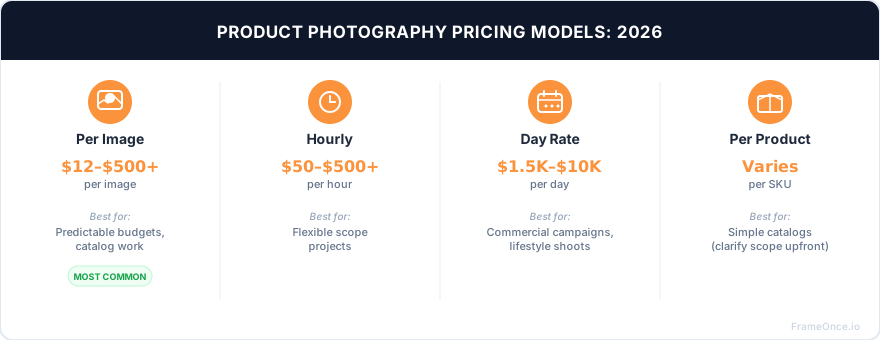
1. Per-Image Pricing
The most common model for ecommerce product photography. You pay a flat rate per final, edited image delivered — regardless of how long the shoot takes or how many angles were captured to get there.
Verified 2026 ranges:
| Image Type | Typical Range |
|---|---|
| Simple white background (catalog/ecommerce) | $12-$75 per image |
| Mid-range (styled, multiple angles, props) | $50-$150 per image |
| Lifestyle / editorial | $100-$500 per image |
| High-end commercial / luxury brand | $300-$500+ per image |
Most professional studios offer volume tiers — the per-image cost drops as you order more. A batch of 50 images will cost significantly less per image than a batch of 10.
Best for: Sellers who know exactly how many images they need and want predictable, budgetable costs.
2. Hourly Pricing
You pay for the photographer's time, regardless of how many images result from that time. Rates in the US in 2026:
- Entry-level / generalist photographers: $50-$150 per hour
- Experienced product specialists: $150-$500 per hour
- Top commercial photographers: $500+ per hour
The problem with hourly pricing for product photography: There's no ceiling on cost. You have no way of knowing in advance how long setup, shooting, and adjustments will take. A photographer quoting $75/hour who spends four hours on what you expected to be a two-hour shoot ends up costing more than a specialist who quoted $200/hour and delivered in two.
Best for: Projects where scope is genuinely unclear, or relationship-based work where you trust the photographer's judgment and efficiency.
Avoid hourly pricing for: Straightforward catalog shoots where you can define the deliverable upfront.
3. Day Rate / Half-Day Rate
Common for larger shoots, commercial campaigns, and lifestyle photography. A full day rate in 2026 typically runs $1,500-$10,000 depending on the photographer's experience and the complexity of the shoot. Half-day rates are usually 60-70% of the full day rate, not exactly half.
Day rates typically include the photographer's time and creative fee. They do not typically include: studio rental, models, stylists, props, or post-production — those are line items on top.
A realistic full-day commercial shoot breakdown:
- Photographer day rate: $1,500-$3,000 (mid-range specialist)
- Studio rental: $75-$150 per hour ($600-$1,200 for an 8-hour day)
- Model (if needed): $50-$250 per hour
- Stylist (if needed): $500-$1,500 per day
- Props: $100-$500
- Post-production / editing: often billed separately at $25-$75 per image
Total for a mid-range lifestyle shoot day: easily $3,000-$8,000 before you factor in retouching.
Best for: Brands launching hero campaigns, seasonal lookbooks, or any shoot involving models, locations, and complex styling.
4. Per-Product Pricing
Some photographers charge per product (SKU) rather than per image. This model is less common because it creates ambiguity — one product might require two images, another ten. Most experienced photographers avoid this structure.
If you see per-product pricing quoted, clarify upfront exactly how many images and angles are included per product. Get it in writing.
What Actually Drives the Cost Up or Down
Volume
The single biggest lever on per-image price. A studio charging $50/image for a 10-image order may charge $20/image for a 100-image order. If you're building a catalog, quote for your total expected volume — not just the first batch.
Product Type and Complexity
Simple, flat objects on white backgrounds are the cheapest to shoot. The cost increases with:
- Reflective surfaces (jewelry, electronics, glassware) — require specialized lighting and more time per shot. See our jewelry photography guide for the specific techniques involved.
- Apparel and clothing — ghost mannequin compositing and model fitting add significant time per SKU. Our clothing photography guide breaks down where the time goes across flat lay, mannequin, and on-model methods.
- Large or heavy products — require more studio space and handling time
- Products requiring assembly or styling — add setup time per SKU
- Transparent or glass products — require specialized backlighting setups
Number of Angles and Shots Per Product
Most ecommerce listings need 3-6 images per product: hero front, 45° angle, back, detail close-up, packaging, lifestyle. Each additional angle is an additional image in the per-image pricing model. Define your shot list before requesting quotes — vague briefs lead to inflated estimates.
Post-Production and Retouching
Basic editing (color correction, white background cleanup) is often included in ecommerce per-image pricing. Advanced retouching is not — and for categories like jewelry, electronics, or cosmetics, advanced retouching can add $10-$30+ per image on top of the shoot cost.
Some brands are now separating shooting from editing: they work with photographers for the capture, then send RAW files to dedicated editing services which often deliver faster turnaround and more consistent results at lower per-image editing costs.
Location and Geography
Photographers in New York and California charge 50-100% more than equivalents in lower cost-of-living markets. Remote studios that accept shipped products exist across price tiers — and for pure white background catalog work, shipping to a remote studio is often the most cost-effective option if you're not in a major metro.
Usage Rights and Licensing
This catches many sellers off guard. Some photographers — particularly at the commercial and editorial end — charge a separate licensing fee on top of the shoot cost. The license determines where and how long you can use the images. Unlimited perpetual rights (website, social, ads, forever) cost more than a one-year single-platform license.
For straightforward ecommerce catalog work, most photographers include full usage rights in the base price. Always confirm this in writing before signing off on a quote.
Turnaround Time
Rush delivery typically adds 25-50% to the base cost. Standard turnaround for professional product photography is 5-10 business days. If your launch timeline is tight, factor this in early — or budget for the rush premium.
DIY vs. Outsourced: Honest Cost Comparison
Many brands start by shooting products themselves, then outsource as volume grows. Here's an honest look at what each approach actually costs.
DIY Product Photography Setup Costs
A functional in-house ecommerce photography setup:
| Item | Approximate Cost |
|---|---|
| Mirrorless camera (e.g., Canon EOS R50) | $679 |
| Macro or standard lens | $200-$500 |
| Two LED softbox lights | $100-$300 |
| Tripod | $50-$150 |
| White sweep / backgrounds | $30-$80 |
| Lightbox (optional, for small products) | $30-$80 |
| Total setup | ~$1,100-$1,800 |
Of every line item in the table above, proper lighting drives more of the final image quality than any other DIY cost line item — a $679 camera with weak lighting will underperform a phone shooting under a well-configured two-light softbox setup. If you're cutting corners to hit the lower end of the budget, cut camera spend before lighting spend.
Ongoing cost: your time. At 15-25 simple images per hour for an experienced shooter with an established setup, factor in your hourly opportunity cost and compare it against outsourcing rates.
The DIY approach makes sense for brands with high-volume, ongoing SKU launches where setup costs are recovered over time. It makes less sense for a 20-product catalog that won't change significantly.
When Outsourcing Makes More Sense
- You have fewer than 50 SKUs and no plans to significantly expand
- Your products are technically difficult (jewelry, glass, reflective surfaces) — specialists deliver better results faster
- Your brand is at a stage where visual quality is a primary competitive differentiator
- You're launching and need turnaround faster than you can produce in-house
There's a third path that's emerged for catalog-stage sellers: applying a consistent visual standard across all your existing photos through post-production, rather than reshooting with a professional. The full economic comparison is in our product photo consistency guide, but the short version is that for 200+ product catalogs, systematic post-processing typically delivers the consistency benefit of a professional photographer at 5-10% of the cost.
Ecommerce Photography Rates: Platform Studios vs. Freelancers vs. Agencies
Not all pricing sources are equal. The same deliverable — 10 white-background product images — can cost very differently depending on who produces it.
Platform studios (Soona, Squareshot, Snappr): $25–$75 per image for standard white background shots. Highly repeatable, predictable turnaround, limited creative direction. Best for straightforward catalog work and Amazon-compliant main images — see our Amazon product photography requirements guide for what compliance looks like.
Freelance product photographers: $50–$200 per image depending on experience and market. More flexibility in creative direction, variable turnaround. Vet by looking at ecommerce-specific work — not portrait or event portfolios.
Full-service agencies: $150–$500+ per image, often with minimum project sizes. Include art direction, styling, and strategic creative. Appropriate for brand launches or premium product lines where visual differentiation is a competitive requirement.
Remote studios that accept shipped products: A growing category. You ship products to a specialized studio, they shoot on a standardized setup, and return edited images on a defined timeline. Often the most cost-effective option for white background catalog work if you're outside a major metro.
For a broader foundation on what makes great product photography, see our complete product photography guide.
How Much Does Product Photography Cost? A Realistic Budget Framework
The honest answer: it depends entirely on what you need. Here's a framework based on actual 2026 market rates:
| Project Type | Budget Range |
|---|---|
| 10 white background images (platform studio) | $250–$750 |
| 10 mid-range styled images (freelancer) | $500–$1,500 |
| 50-image catalog batch (specialist studio) | $1,000–$3,500 |
| Full-day lifestyle shoot (agency) | $3,000–$15,000+ |
| DIY setup (one-time) | $1,100–$1,800 |
The DIY setup cost recovers quickly if you have ongoing product launches. If you're building your setup, our product photography setup guide covers exactly what gear you need and how to configure it.
Platform-Specific Pricing (Soona, Squareshot, and Similar)
A category of on-demand product photography studios now operates as platforms — you ship your products, choose a package, and receive images within a defined turnaround window. These platforms have made professional photography accessible at lower minimums than traditional studios.
Examples of 2026 platform pricing:
- Soona: starts at $39 per image for standard shots
- Squareshot: tiered per-image pricing with volume discounts
- Snappr: marketplace model connecting brands with local photographers at standardized rates
These platforms are well-suited for straightforward catalog work and brands that need speed and predictability. They are less suited for complex, highly styled, or brand-specific work that requires significant creative direction.
What You Should Actually Ask For When Requesting Quotes
Most pricing confusion comes from comparing quotes that cover different things. When requesting quotes, specify:
- Total number of images needed (not products — images)
- Image types: white background catalog, lifestyle, detail shots — broken down
- Shot list per SKU: how many angles per product
- Post-production included: what's in the base price vs. additional
- Usage rights: confirm unlimited, perpetual, all-platform usage is included
- Turnaround time: standard vs. rush
- Revision policy: how many rounds of revisions are included
- Shipping: if remote, who covers inbound and return shipping costs for products
Getting all of these defined upfront turns an ambiguous quote into an apples-to-apples comparison.
The Hidden Cost Most Sellers Overlook: Inconsistency
There's a cost that doesn't appear on any photographer's invoice but shows up directly in your conversion rate: visual inconsistency across your catalog.
A seller who shoots 50 products across three separate sessions — even with the same photographer — often ends up with subtle variations in background tone, lighting temperature, crop ratio, and product positioning. On a Shopify collection grid or Amazon search results page, that inconsistency is immediately visible. It signals lower quality, even when individual images are technically strong.
The traditional solution is to reshoot everything together, which adds cost. Or to create an extremely detailed style guide and enforce it across every session, which adds coordination overhead.
This is the problem FrameOnce is built to solve. Rather than relying on manual matching and hoping the light temperature is the same as three months ago, you set a Style Preset from a reference image — and new product photos are automatically matched to it for background, lighting character, crop, and visual consistency. Your 100th product photo matches your first, regardless of when or where it was shot.
Worth saying plainly given how much AI-generated imagery is showing up online: FrameOnce enhances the real photos you already shot. It does not generate fake products or fabricated stand-in imagery — every output starts from your own photograph (see our Real Photos policy).
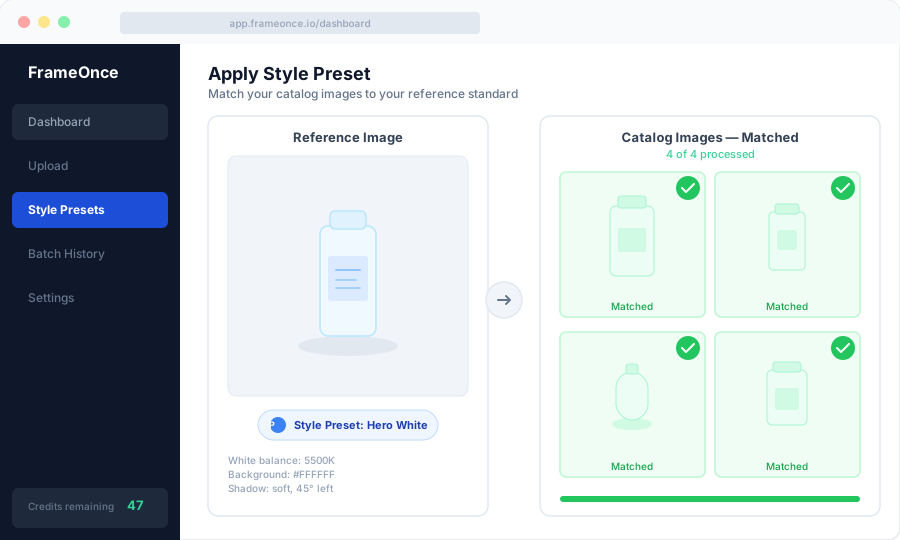
FrameOnce's free tools are live now. Run a free shop critique to see exactly where your catalog drifts, no signup needed. The full paid catalog workflow (Style Presets, batch processing, Etsy/Shopify integration) is in private testing and launches summer 2026; join the waitlist for double credits when paid plans are ready.
Quick-Reference: What to Budget by Business Stage
Just starting out (under 25 SKUs):
DIY with a basic setup (~$1,100-$1,800 one-time) or use a platform studio like Soona at $39-$75/image. Keep it simple: white background only, 3 angles per product.
Growing brand (25-100 SKUs):
Per-image pricing from a specialist studio at $25-$75/image for catalog, $100-$200/image for lifestyle. Budget separately for annual seasonal lifestyle shoots.
Established brand (100+ SKUs, ongoing launches):
Consider in-house setup for catalog work (volume justifies the investment) plus outsourced lifestyle shoots 2-4x per year. Total annual photography budget: $10,000-$50,000+ depending on category and launch frequency.
Enterprise / premium brand:
Day-rate commercial studios with full creative direction. Budget $5,000-$15,000 per shoot day inclusive of all line items.
Frequently Asked Questions
Is cheaper product photography always worse quality?
Not necessarily. Platform studios like Soona have made professional-quality white background photography available at lower price points by standardizing their process. Where you generally do get what you pay for is in creative direction, styling, and complex technical setups — a $15/image service won't deliver the same result as a $150/image specialist for jewelry or cosmetics.
Do I need to pay for usage rights separately?
For most ecommerce catalog photography, usage rights are included in the base price. Always confirm this. For commercial campaigns, editorial use, or advertising, usage licensing may be billed separately and can add significantly to the total cost.
How many images do I actually need per product?
For most ecommerce listings: 4-6 is the practical standard. Amazon allows up to 9 images. Listings with 5-8 images consistently outperform those with 1-3. At minimum: one clean hero image, one 45° angle, one back or detail shot, one lifestyle or in-context image.
What's a reasonable budget for a brand just launching?
For a 20-product catalog at 4 images per product (80 images total), expect to spend $800-$2,500 for white background catalog work outsourced to a platform studio, or $1,100-$1,800 upfront to build a basic DIY setup and produce them yourself.
Should I hire locally or ship to a remote studio?
For white background catalog work, remote studios are often more cost-effective and produce more consistent results due to standardized setups. For lifestyle work requiring location or models, local is usually more practical.
Summary
Product photography pricing in 2026 ranges from $12 to $500+ per image depending on complexity, volume, and the type of service. Per-image pricing from a specialist studio is the most predictable model for ecommerce catalog work. Day rates are for complex commercial shoots. DIY makes sense at sustained volume with simple products. Platform studios bridge the gap for brands that need professional quality without the overhead of a full commercial studio relationship.
The number on the invoice isn't the full cost — factor in retouching, usage rights, turnaround, and the long-term cost of inconsistency across a growing catalog.
Ready to eliminate inconsistency from your catalog? Run a free shop critique to see exactly where your photos drift today — no signup needed. Or join the waitlist for double credits when the paid catalog workflow launches summer 2026.
FrameOnce Team
FrameOnce Team
Related Articles
Shopify Product Image Size: Complete 2026 Guide
Every Shopify image size in one place: product photos, collections, banners, logos. 2026 specs direct from Shopify, plus consistency tips.
Catalog Photography: How to Keep 100+ Product Photos Looking Like One Cohesive Brand
Keep 100+ product photos looking cohesive: workflow, lighting standards, color management, and tools for ecommerce sellers at scale.
Smartphone Product Photography: How to Get Professional Results With Your Phone
Pro product photos from your phone: iPhone and Android settings, DIY lighting, backgrounds, and editing for Etsy and Shopify sellers.
Stay Updated
Honest product photography tips delivered to your inbox. FrameOnce enhances the photos you take, real photos, never generated.