Product Photography Equipment: What You Actually Need (and What You Don't)
The complete product photography equipment list by budget tier: from $50 phone setups to full studio rigs, with what's worth buying and what to skip.
Most product photography equipment guides tell you to spend $3,000 before you shoot your first image. That's wrong. Most guides also tell you a smartphone is enough for professional results. That's also wrong — for most categories.
The truth is somewhere between the two extremes, and it depends heavily on what you're selling, how many products you have, and where you're selling them. This guide breaks down every piece of equipment you'll encounter — camera, lighting, backgrounds, accessories — at three budget tiers, with honest assessments of what's worth the money and what isn't.
For the broader context of building a repeatable setup around this equipment, see our product photography setup guide.
The Only Honest Framework for Buying Photography Equipment
Before spending anything, answer these three questions:
1. What product category are you shooting?
Simple flat products (packaged goods, folded clothing, books) need minimal equipment. Reflective products (jewelry, electronics, glass) need specialized lighting. Large or heavy products need more studio space and rigging.
2. How many products do you have?
Under 50 SKUs with no plans to expand significantly: outsource. The setup investment doesn't recover. Over 100 SKUs with ongoing launches: DIY is almost always more cost-effective over time.
3. Where will these images be used?
Amazon requires pure white backgrounds and strict size minimums — see our Amazon product photography requirements guide for the full compliance checklist. Shopify and Etsy have more flexibility. Lifestyle brand photography has completely different requirements than catalog photography.
Once you can answer these, the right equipment list becomes obvious.
The Camera: Start Lower Than You Think
The camera body is the least important equipment decision in product photography. Lighting setup, background quality, and consistency practices matter more than sensor megapixels.
Smartphones (Free to $1,499)
Best for: Beginners, small catalogs, flat products, brands where content is primary and catalog refinement comes later.
Modern flagship phones — iPhone 15 Pro, Google Pixel 8 Pro, Samsung Galaxy S24 Ultra — produce genuinely excellent product images when used correctly. The key is treating them like cameras:
- Use the native camera app rather than third-party apps for RAW capture
- Lock exposure and white balance manually using the exposure lock
- Use a tripod (non-negotiable — handheld phone shots lack the consistency you need)
- Shoot in the highest quality JPEG or ProRAW available
Where smartphones fall short: in low-light studio conditions, with highly reflective products, or when you need manual control over aperture for depth of field. For jewelry or any product requiring a macro lens, smartphones with clip-on macro attachments rarely deliver reliable results.
For a complete walkthrough of phone-specific settings, lighting setups, and editing apps, see our smartphone product photography guide.
Entry-Level Mirrorless ($400–$800)
Best for: Growing brands, anyone selling on Amazon, sellers who need consistent repeatable results across hundreds of SKUs.
The Sony a6000 series, Canon EOS R50/R100, and Fujifilm X-T30 are the workhorses of ecommerce photography for good reason. The main advantage over smartphones isn't image quality — it's control. You can lock every setting precisely, attach specialized lenses, and get identical results every session without guessing.
Recommended picks:
- Canon EOS R50 (~$679): Best autofocus in class, excellent color science, Dual Pixel AF works well for live view product shooting
- Sony a6400 (~$848): Excellent image quality, superior video (useful for lifestyle content), slightly more complex menu system
- Fujifilm X-T30 II (~$1,299): Film simulations are excellent for lifestyle work, very compact, great for apparel and lifestyle
DSLR vs. Mirrorless in 2026
DSLRs are no longer the recommended choice for new setups. Mirrorless cameras offer better live view, equivalent image quality, and a more sustainable system for lenses and accessories going forward. If you already own a DSLR, use it — but don't buy a new one.
Full-Frame Cameras ($2,000+)
Worth it for product photography? Rarely. The image quality advantage of full-frame over APS-C is marginal for catalog work where you're shooting at f/8–f/11. The additional cost, size, and weight are not justified for most ecommerce applications.
The exception: if you're producing very large format prints, licensing images for billboard or large-scale retail display, or shooting high-end lifestyle content where shallow depth of field is a creative requirement.
Lenses: Where to Actually Spend Money
Unlike camera bodies, the lens matters significantly for product photography.
Standard Zoom Lenses (Kit Lenses)
Kit lenses (typically 18–55mm on APS-C cameras) are adequate for apparel, packaged goods, and most simple product categories — see our clothing photography guide for the specific lens and focal-length choices that work for flat lay, ghost mannequin, and on-model shoots. They're not ideal for:
- Products requiring close-up detail (jewelry, cosmetics, electronics)
- Any situation where barrel distortion matters (flat lay work at wider focal lengths)
Prime Lenses ($200–$600)
A 35mm or 50mm prime lens on an APS-C camera (equivalent to 52mm or 75mm full-frame) produces noticeably sharper images than kit zooms, particularly in the corners. For flat lay work, a 35mm prime eliminates the barrel distortion that makes products look warped at the edges.
Recommended:
- Canon RF 35mm f/1.8 Macro (~$450): Works for both flat lay and some close-up work, excellent sharpness
- Sony E 35mm f/1.8 (~$450): Outstanding sharpness for Sony APS-C systems
Macro Lenses ($400–$900)
Non-negotiable for: jewelry, watches, cosmetics, electronics with fine detail, any product where fine texture or engraving is part of the product story.
A true macro lens with a 1:1 magnification ratio projects the subject onto the sensor at actual size, giving you the resolution to show gemstone facets, fabric weave, and surface detail clearly.
Best options:
- Canon RF 100mm f/2.8L Macro (~$1,199): Industry standard for jewelry photography
- Sony FE 90mm f/2.8 Macro (~$1,098): Outstanding resolution, works on full-frame and APS-C Sony
- Sigma 105mm f/2.8 DG DN Macro (~$799): Strong, lower-cost alternative compatible with Sony E and L mounts
For a full breakdown of jewelry-specific equipment and techniques, see our jewelry photography guide.
Lighting Equipment: The Most Important Investment
If you're going to spend money on one thing in product photography, spend it on lighting. A well-lit image with a mid-range camera beats a poorly lit image with an expensive one every time.
Natural Light (Free)
A large north-facing window provides soft, diffused light that works well for lifestyle products, cosmetics, food, and apparel.
Limitations:
- Changes throughout the day and across seasons
- Cloud cover creates inconsistency between sessions
- Cannot be controlled or replicated precisely
For catalog work requiring consistency across months of shoots, natural light creates problems that compound over time. Use it for lifestyle and social content; build an artificial lighting setup for catalog work.
LED Softboxes ($80–$300 for a pair)
Two LED softboxes are the standard setup for ecommerce product photography. A two-light arrangement covers almost every product category effectively.
What to look for:
- CRI (Color Rendering Index): 95 or higher for accurate color rendering. This is critical for fashion, cosmetics, and anything where color trust matters. A CRI of 80 is not sufficient for professional product work.
- Color temperature control: Adjustable from 3200K (warm) to 6500K (daylight). Fixed-temperature lights are acceptable but less flexible.
- Power control: 0–100% dimming so you can dial in exact ratios between key and fill lights.
Recommended setups:
- Neewer 2-Pack 18" LED Softbox (~$120 for both): Solid entry-level option, CRI 95+, adequate for most categories
- Godox SL60W + Softbox (~$130 per light): More powerful, better build quality, excellent for larger products or when you need to light larger areas
- Aputure Amaran 60x S (~$149 per light): Bi-color (2700–6500K), very consistent output, worth the extra cost for professional setups
Ring Lights ($40–$150)
Ring lights are commonly used for product photography on a budget — but they're not ideal for most product types. The circular reflection they create shows up clearly on any reflective surface: cosmetics packaging, electronics, jewelry, glass, polished plastics.
Use ring lights for: social content, lifestyle shots, cosmetics application demos.
Avoid ring lights for: white background catalog photography with any reflective product.
Lightboxes / Light Tents ($30–$150)
A collapsible lightbox is the most effective setup for small products: jewelry, cosmetics, watches, electronics, small packaged goods.
The enclosed diffusion panels eliminate most reflections automatically and create even light from all sides. Setup time once you own one: under 5 minutes. The tradeoff is limited creative control — every image from a lightbox looks similar, which is actually an advantage for catalog consistency.
Recommended:
- Neewer 20-inch collapsible light tent (~$50–90): Works well for items under 10 inches
- Neewer 24-inch collapsible light tent (~$60–100): Better diffusion, more room for slightly larger items
- StudioPRO LED lightbox (~$90–$150): Built-in LED strips eliminate the need for separate lights
Backgrounds
White Seamless Paper Roll ($20–$50)
The professional standard for white background photography. Comes in 107-inch wide rolls that provide a seamless infinity background with no visible seams or edges. Replace sections when they get dirty or scuffed — paper is inexpensive.
Best brands: Savage Universal, Backdrop Express. Available at most photography retailers.
White Foam Board ($2–$5 per sheet)
Available at any dollar store. Works perfectly for tabletop setups. Cut to size, curve up behind the product for a seamless sweep background. Replace when damaged.
Best for: small to medium products on a budget.
Vinyl Backdrops ($30–$100)
Reusable, cleanable alternatives to paper. Available in marble, wood, concrete, and other lifestyle textures for secondary images. For Amazon main images, white or pure white only.
Essential Accessories
Tripod ($50–$200)
Non-negotiable. Without a tripod, you cannot consistently replicate framing, you'll introduce camera shake at low ISO settings, and focus stacking (required for jewelry) is impossible.
What to look for:
- Adjustable center column that extends overhead (for flat lay photography)
- Load capacity of at least 5kg (11 lbs) to hold camera and lens comfortably
- Ball head with arca-swiss plate compatibility for fast camera changes
Recommended:
- AmazonBasics 60-inch tripod (~$25): Not recommended — cheaply built, unreliable ball head
- Manfrotto 290 Xtra (~$200–250): Solid, reliable, good ergonomics for product photography
- JOBY GorillaPod 5K (~$175–200): Flexible legs useful for tabletop setups, not for full studio rigs
Remote Shutter Release ($10–$30)
Eliminates camera shake from pressing the shutter button. Essential for macro photography, focus stacking, and any shot at ISO 100 with longer shutter speeds. Most mirrorless cameras support Bluetooth or wired remote releases.
Color Calibration Card ($15–$40)
A grey card or X-Rite ColorChecker Passport allows you to set a custom white balance in-camera and in post, ensuring consistent, accurate color across an entire shoot. Photograph the card under your lights at the start of each session, set a custom white balance in-camera, and use it as a reference in post.
For fashion and cosmetics where color accuracy is a purchase-decision factor, this is worth the investment.
Reflectors ($10–$30)
A simple white foam core board — available at any dollar store — acts as a fill reflector by bouncing light back into shadows on the opposite side of your key light. It costs $2 and does the job of a $30 reflector panel.
For more control, a 5-in-1 reversible reflector ($15–$30) provides white, silver, gold, black, and diffusion surfaces in one collapsible disc.
Clamps and Boom Arms ($15–$80)
- A-clamps: For holding foam boards, reflectors, and backgrounds in position without stands
- Boom arm: Required for overhead flat lay photography. A ceiling-mounted boom arm or a tripod-mounted boom arm keeps the camera directly overhead without requiring a separate overhead rig
Complete Equipment Lists by Budget
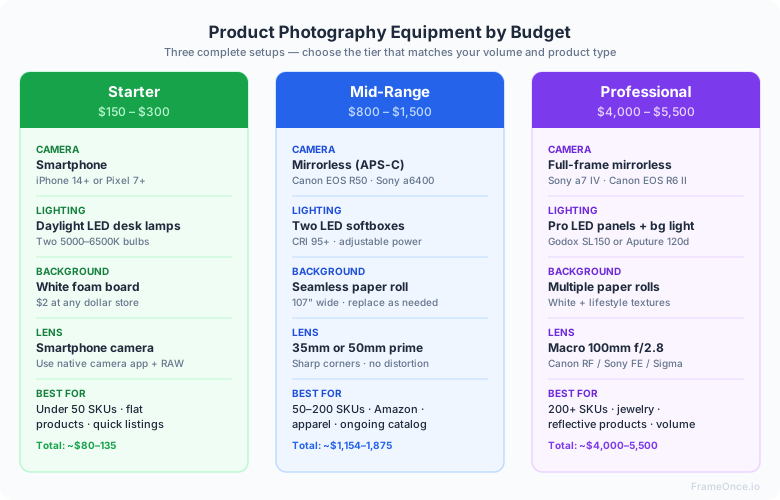
Starter Setup: $150–$300
For sellers with under 50 products, straightforward products, and no budget for significant equipment.
| Item | Approximate Cost |
|---|---|
| Smartphone (use what you own) | $0 |
| Tripod with phone mount | $25–$50 |
| Two LED desk lamps with daylight bulbs | $20–$40 |
| White foam board (4 sheets) | $10 |
| White seamless paper (small roll) | $20–$30 |
| Styling clips | $5 |
| Total | $80–$135 |
Mid-Range Setup: $800–$1,500
For growing brands with 50–200 products and ongoing catalog expansion.
| Item | Approximate Cost |
|---|---|
| Entry-level mirrorless camera (Canon EOS R50 or Sony a6400) | $679–$900 |
| 35mm or 50mm prime lens | $200–$450 |
| Two LED softboxes with stands | $120–$250 |
| Tripod | $80–$200 |
| White seamless paper roll | $30 |
| White foam board | $10 |
| Remote shutter release | $15 |
| Color calibration card | $20 |
| Total | $1,154–$1,875 |
Professional Setup: $2,500–$4,500
For established brands with ongoing high-volume catalog work and technically demanding product categories.
| Item | Approximate Cost |
|---|---|
| Mirrorless camera body (Sony a7 IV or Canon EOS R6 Mark II) | $1,800–$2,500 |
| Macro lens (Canon RF 100mm or Sony FE 90mm) | $1,098–$1,199 |
| Two professional LED lights (Godox SL150 or Aputure 120d) | $600–$1,000 |
| Large softboxes (90cm × 90cm) | $100–$200 |
| Professional tripod (Manfrotto) | $200–$300 |
| Background paper rolls (multiple colors) | $50–$100 |
| Remote shutter release | $30 |
| Color calibration passport | $100 |
| Lightbox for small products | $50–$100 |
| Total | $3,880–$5,200 |
What Not to Buy
Ring lights for catalog photography. As noted above, the circular reflection ruins any shot with a reflective surface.
Large format studio strobes (unless you know you need them). Continuous LED lights give you what you see as you shoot — strobes require metering and preview experience to use effectively. For product photography, continuous LEDs are the better starting point.
Expensive camera bodies before upgrading your lens. A mid-range mirrorless with a quality prime lens outperforms an expensive body with a kit lens.
A huge paper background sweep for tabletop products. A 53-inch wide paper roll is overkill for a product that's 8 inches wide. Match your background size to your product size.
Frequently Asked Questions
Do I need a studio for product photography?
No. Most ecommerce brands start with a corner of a room, two softboxes, and a white background. The "studio" is a setup that can be reproduced consistently — not a location.
What camera should I buy for product photography?
For most sellers: the Canon EOS R50 ($679) is the best value entry-level mirrorless camera for product photography in 2026. If you're on a tighter budget, a used Canon EOS M50 Mark II ($220–380) is a capable alternative.
Is a mirrorless camera better than a DSLR for product photography?
Yes, for new purchases. Live view on mirrorless cameras is significantly better for tripod-mounted product shooting, and the mirrorless ecosystem will continue to receive new lenses and accessories while DSLR development has effectively ended.
How important is the lens for product photography?
Very. For most product categories, upgrading from a kit lens to a prime lens will produce more noticeable improvements than upgrading the camera body.
Can I use my phone instead of a camera?
For many product categories, yes — particularly if you're starting out, have a limited budget, and are selling on platforms that don't require maximum resolution. For jewelry, highly reflective products, or anything requiring macro detail, a dedicated camera with a macro lens is necessary.
Summary
The right equipment depends on your product category, volume, and budget — not on what a gear review says a professional photographer uses. Start with the minimum equipment that meets your image quality requirements for your specific platform and product, and upgrade when you've identified the specific bottleneck. If you're still weighing DIY against hiring a studio, our product photography pricing guide breaks down the actual per-image and day-rate costs in 2026.
For most ecommerce sellers, the highest-ROI investment is lighting — specifically, two LED softboxes with a high CRI rating — followed by a tripod, followed by a prime lens. The camera body is almost always the last thing worth upgrading.
Once you have the gear and start photographing real inventory at scale, the catalog-consistency problem becomes the next bottleneck — and that is what FrameOnce is built for. To be clear about what FrameOnce is: it enhances the photos you took with whatever equipment you own. It does not generate fake products from prompts (see our Real Photos policy).
Ready to make your catalog consistent across all that equipment? Run a free shop critique to see exactly where your photos drift today, free, no signup needed. Or join the waitlist for double credits when the paid catalog workflow launches summer 2026.
FrameOnce Team
FrameOnce Team
Related Articles
Product Photography Lighting: A Complete Guide to Consistent Results
Product photography lighting guide: natural vs. artificial setups, camera settings, softbox positions, and consistency techniques for ecommerce catalogs.
White Background Product Photography: The Complete Guide for E-Commerce
How to shoot white background product photos for Amazon, Etsy, and Shopify: setup, lighting, and editing for a perfectly consistent product catalog.
How to Photograph Jewelry: 10 Tips for Catalog-Ready Results
Learn how to photograph jewelry at home: macro lens setup, lighting to control reflections, focus stacking for 3D pieces, and camera settings for ecommerce.
Stay Updated
Honest product photography tips delivered to your inbox. FrameOnce enhances the photos you take, real photos, never generated.